November 2014

Kare Kare… a Meat Stew Perfect for the Winter!

Last week was real cold… and breezy to boot. Perfect weather for a meaty stew. I had been planning to make a Kare Kare for a few days and last week, I finally got around to it. And man, am I glad! It looked good, tasted good, and was healthy as well!

KKMSPG-ready

The vibrant orange colour of the dish is achieved by the use of achiote seeds, something new for me.

Achiote seeds are commonly used in Latin American and Caribbean cuisines to add colour and flavour to food. I had seen them used by one of my friends from Puerto Rico and I was charmed. And I bought a bottle of the seeds from a Hispanic store. So the Kare Kare was the perfect opportunity to try it out!

KKMSPG-achiote

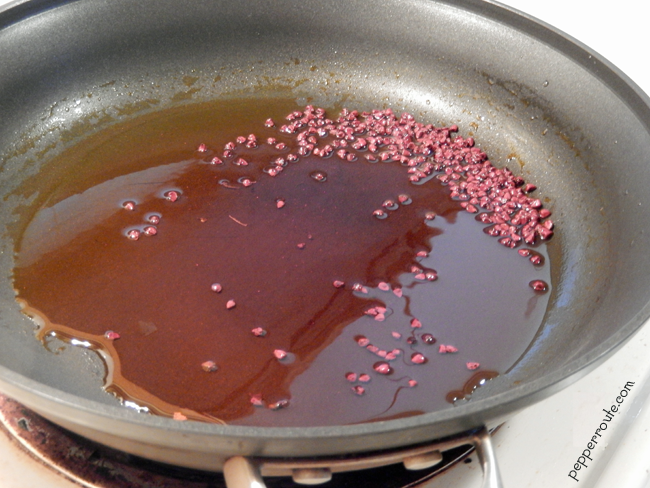
The seeds are not used directly in the food; at least that is what my friend told me. You soak it in some water and use that water for adding colour to food. Or you can fry it in some oil and use the oil for colour. Achiote is also available in powder form, which actually is the extracted colour mixed with corn flour.
KKMSPG-achiote-oil

To use achiote with oil, heat the oil and add a teaspoon of the seeds. Keep stirring on a low heat. When the seeds turn dark, take off the heat and discard the seeds. You can use the oil like any other oil for cooking, and it will add a brilliant yellow-orange colour to whatever you cook.

KKMSPG-achiote-colour

See how the drained seeds (to be discarded) have stained the paper towel!

The achiote trees are a warm weather species, growing around the world.

In addition to the seeds, the pericarp covering of the seeds are also used for colour extraction. Since ancient times, achiote has been used to add colour to cheeses and other dairy products and processed foods.

KKMSPG-plated

Traditionally, the meat used for Kare Kare is oxtails. You can also add pork hocks or different cuts of beef. I used a combination of oxtails and short ribs with perfect results.

KKMSPG-closeup

The meats are first cooked in a broth. As the oxtails are quite fatty, it is a good idea to remove most of the pure fat from the broth. I usually cook the meat the previous day and pop it in the refrigerator overnight so that the fat can be easily and completely removed.

KKMSPG-ingredients

The health aspect of this dish is that it hits a perfect balance of meat and vegetables. Yard long beans (sitaw), bok choy, and eggplant are the most commonly used vegetables. I added a red pepper as well, for the colour.

This all around great dish has its origin in Philippines, where it is commonly served on festive occasions.

Kare Kare... a Meat Stew Perfect for the Winter!
 
Author: 
Recipe type: Entree
Kare Kare is ideally cooked over two days - cook the meat in the stock the first day and finish the dish the second day. This way, you can get rid of the excess fat content from the oxtails easily.
Ingredients
  • 4 pieces of oxtail, 2 inch thick
  • 2 lbs of beef; bone-in cuts like short ribs work best
  • 2 onions
  • 8 cloves of garlic
  • 1 tsp black peppercorns
  • 6 cloves
  • A small bunch yard long beans (sitaw)
  • 1 large bok choy or a bunch of baby bok choy
  • 1 purple eggplant
  • 1 red pepper
  • 4 tbsp all-natural peanut butter
  • 2 tbsp fish sauce
  • 1 tsp achiote seeds
  • 2 tbsp cooking oil
  • Salt and black pepper to taste
  • Cooked rice and shrimp paste to serve
Directions
  1. One day one, cut the beef into large pieces.
  2. Place the oxtail pieces and the beef pieces in a large pot.
  3. Cut one onion into big wedges and add to the meat.
  4. Crush 4 of the garlic cloves with their skin on and add to the meat.
  5. Add the whole peppercorns and cloves to the pot as well.
  6. Pour cold water up to two inches above the meat and bring to a boil.
  7. Simmer on low heat till the meat is very tender (usually takes 2 to 2 ½ hours), stirring once in a while.
  8. Add more water to the pot as required, to maintain the level. At the end you should have seven to eight cups of stock.
  9. When the meat is cooked well, remove from the heat and allow to cool.
  10. Keep in the refrigerator overnight or for at least three hours.
  11. When ready to continue, bring the pot out of the refrigerator and carefully remove and discard the sheet of fat on the top.
  12. Carefully remove the meat pieces onto a platter.
  13. Sieve the stock and discard the solids.
  14. Cut the remaining onion into smallish wedges.
  15. Skin and thinly slice the remaining 4 garlic cloves.
  16. Cut the vegetables into two-inch long narrow pieces.
  17. In a large pan, heat the oil on medium heat.
  18. Add the achiote seeds, reduce the heat to low and keep stirring.
  19. When the achiote seeds get dark, remove from the heat and separate and discard the seeds.
  20. Return the pan with the oil to the stove and add the onions.
  21. When they start to brown around the edges, add the garlic and sauté for a minute.
  22. Add the peanut butter, fish sauce and the stock.
  23. Stir together and bring to boil.
  24. Add the cooked meat and cut vegetables to the pot.
  25. Season with salt and freshly ground black pepper.
  26. Cook till the vegetables are done yet crisp.
  27. Remove from heat and serve with cooked rice and sautéed shrimp paste (bagoong) on the side. Yum!

~Ria


Warm Three Bean Dip

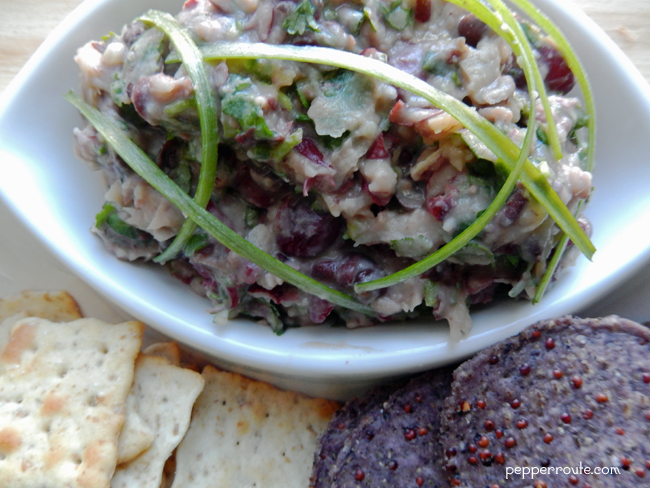
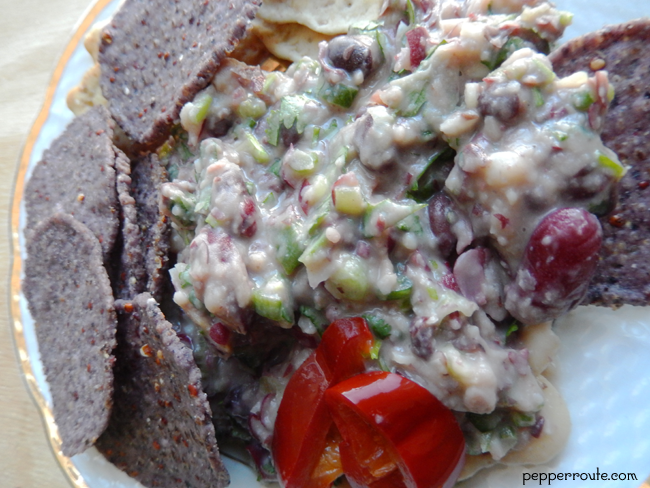
Though the name refers to a dip, this actually is not a dip. The only apt word I can think of is ‘scoop’. Instead of dipping your chip into something, you are scooping something with your chip. You get the idea!

WTBD-closeup2

Beans are one of the most ancient crops consumed by human beings. Historical evidence points to its consumption in regions widespread in Asia and South America, starting 7th millennium BC. Actual cultivation started later in the 2nd millennium BC. Today, it must be one of the most common staples present in all cuisines around the world.

Strictly speaking, beans like fava beans (broad beans) belonging to a particular species can be called ‘beans’, but in modern usage, the word has become a synonym for pulses or legumes as well. Then there are other thing being called ‘beans’ though they are in no way connected to the actual beans. Examples are coffee bean, vanilla bean, coco bean, etc.

WTBD-plated2

The beans’ claim to fame is that it is the chief food item that meets the protein requirements of vegetarians. According to nutrition experts, beans are comparable to meat in terms of calories, but far superior when it comes to fiber and water content. One cup of cooked beans provides about 12 grams of fiber, while meat has none. In addition, beans are high in antioxidants, and are good for digestive tract health.

WTBD-ingredients

Instead of the particular varieties of beans used here, you can choose any of your liking.

WTBD-grinding

The molcajete goes well with the ancient crop of beans as it is also an ancient tool. It was in use during the times of the Aztec and Maya cultures. It is carved out of a single block of basalt stone. Comes in very handy in the kitchen.

WTBD-plated1

Despite all the good it does, beans have this unfortunate blemish on its reputation due to its tendency to produce flatulence, giving rise to numerous stories and jokes. Soaking in water to which a pinch of baking soda has been added, or cooking with spices like coriander and cumin are supposed to overcome this problem. Again, in my opinion, moderate quantities will not cause any such problems.

WTBD-closeup1

The dip or scoop is served best with sturdy tortilla chips. And, if you like to spice it up a bit, try it with pieces of pickled jalapeno on the side… truly kicks it up a notch. A quick lunch or a snack, with hardly any effort!

~Ria


Warm Three Bean Dip
 
Author: 
Recipe type: Snack
Ingredients
  • 1 cup butter beans
  • 1 cup red kidney beans
  • 1 cup black beans
  • 2 cloves garlic
  • 1 tbsp olive oil
  • 1 lime
  • 1 bunch (4 or 5) scallions
  • 1 bunch cilantro leaves
Directions
  1. If using the cans of already cooked beans, drain and wash the beans. If using dry beans, soak them for 6 hours ahead of time and boil them.
  2. Thinly slice the scallions and cilantro leaves.
  3. Juice the lemon.
  4. Using a molcajete (traditional grinding stone from Mexico), crush the garlic cloves. If you do not have a molcajete, you can use any other means for the crushing.
  5. Add the three beans and crush them, along with the garlic. It is not necessary to make each bean into a paste; a rough crushing will do. It is good to leave a few whole beans uncrushed.
  6. Scoop out the crushed beans into a serving dish.
  7. Add the olive oil, lime juice, and salt, and mix well.
  8. Add the sliced scallions and cilantro and blend in.
  9. Keep aside for 30 minutes at room temperature for the flavours to meld.
  10. Serve with tortilla chips and crackers to scoop.


Kale with Coconut and Garbanzo

Winter is here and the hardy kale is one of the staples of the season. Among all the leafy vegetables, it occupies a unique place, in terms of history as well as nutritional benefits. And it has an enduring role in almost all cuisines of the world. Being very versatile, it can be made into a variety of soups, pies, salads, sides… a wide choice indeed!

KCGB-closeup2

Kale is a member of the cabbage family, though the leaves do not form a head in the center. Other members of the family include broccoli, cauliflower, collard greens, and brussels sprouts.

The commonly available varieties are curly kale and plain kale, in a dark green to gray green colour. There are also varieties that come in white and purple colour, though not commonly available in the market.

Kale is one of the earliest known vegetable, having been cultivated for over 2,000 years. There is evidence of its consumption in Greece in 4th century BC. It was the most common green vegetable in Europe during the Middle Ages, mainly due to its ability to withstand the harsh winter weather.

KCGB-plated1

There are several indications of this leafy vegetable’s historical importance in current culture and usage. An example would be the prominence of the word ‘kale’ in Scottish phrases in use even today. A kaleyard or kailyard as it is spelt in Scottish, is a kitchen garden. And the phrase ‘off one’s kale’ actually means too ill to eat!

It is very easy to grow, being tolerant of extremes of weather. However, not all varieties of kale are edible as some are coarse and indigestible.

Kale is rich in vitamin C and K, and beta carotene, in addition to calcium. It is also known to possess anti-cancer and DNA repair properties, along with the ability to lower cholesterol.

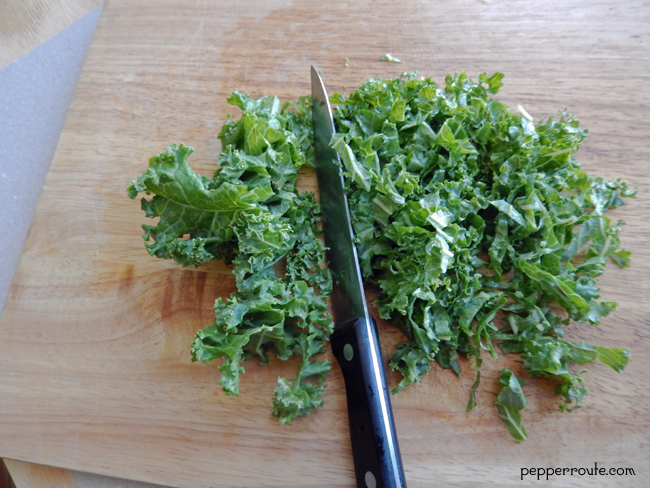
The stems of the kale leaves are quite tough and need to be removed. Just cut along the two sides of the stem and to separate and discard it.

KCGB-cutting-kale1

The leaf part can then be sliced to the size you want.

KCGB-cutting-kale2

This dish is simplicity itself, yet tastes great, and is quick to make, with just a few ingredients.

KCGB-ingredients

I have used curly kale and cooked it without adding any extra liquids, which is the best way to cook leafy green vegetables.

KCGB-plated2

You could easily substitute any other bean like cannellini or butter beans for the garbanzo beans. Best eaten with boiled or steamed rice.

KCGB-closeup1

Did you know that the ornamental kale in white, pink and purple that you see decorating many a front garden is edible as well?

~Ria

Kale with Coconut and Garbanzo
 
Author: 
Recipe type: Sides
Ingredients
  • 1 bunch curly kale leaves
  • 1 cup heaped, cooked garbanzo beans
  • ½ cup scraped coconut (can be fresh or frozen thawed)
  • 1 medium yellow or white onion
  • 2 cloves garlic
  • 1 tbsp cooking oil
  • A pinch red chili flakes (optional)
  • Salt and black pepper to taste
Directions
  1. Remove the central stem of the kale leaves. Gather the leaves together into small bunches and slice thinly.
  2. Cut the onion into ¼ inch wedges.
  3. Crush the garlic.
  4. In a large pan, heat the cooking oil.
  5. Add the onion wedges and sauté till they are transparent.
  6. Add the garlic and sauté for another minute.
  7. Add the kale leaves and stir. The leaves will start to wilt right away.
  8. When they are fully wilted, add the garbanzo beans.
  9. Add salt and freshly ground black pepper to taste and mix well.
  10. When all the liquid from the kale has evaporated, in two or three minutes, add the coconut (and the chili flakes, if using) and mix.
  11. Remove from heat and serve right away, as lunch or a side to dinner.